The FEEL Benchmark & Data Engine
A reproducible visuo-tactile collection setup with hardware blueprints and spatio-temporal synchronization algorithms.
Data Collection Pipeline
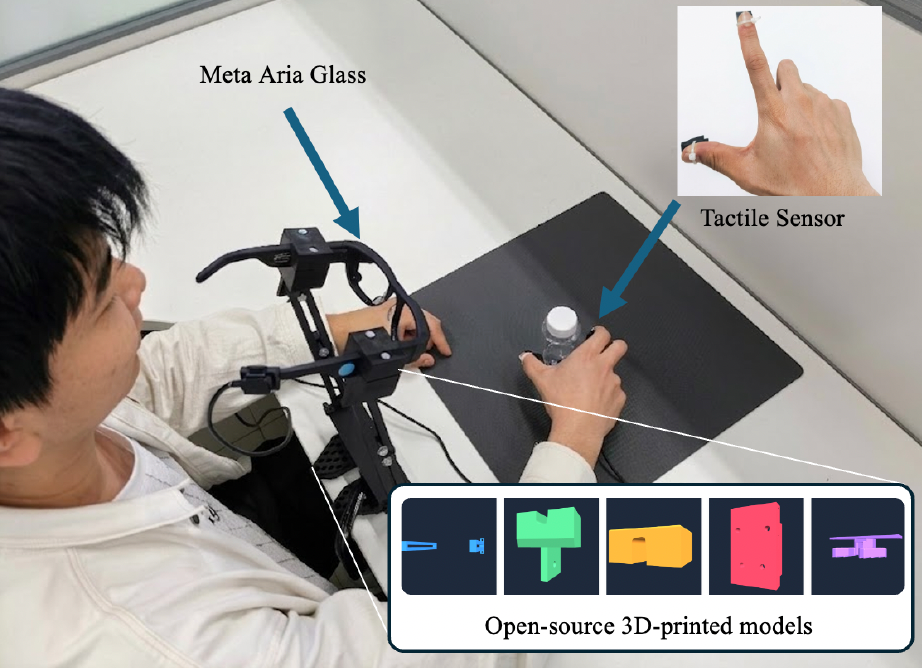
Meta Aria Glasses
6-DoF wrist & finger poses via MPS · mm accuracy
3D-Print Blueprint
Open-source STL + BOM for low-cost sensor mount
Paxini PX6AX Tactile Sensor
PX6AX-GEN3-DP-S2015-Elite on thumb & index · high-res fingertip force / deformation
Spatio-Temporal Sync
Browser-based temporal alignment with manual refinement for Aria RGB, MPS hand poses, and tactile force
FEEL Dataset
F/D/V taxonomy · boundary & mismatch samples
FEEL v2.1 at a Glance
The latest FEEL release expands both scale and participant diversity, enabling cross-participant evaluation and per-axis fingertip-force research.
Release growth · v1 → v2.1
Episodes by object category
Designed for generalization: four anonymized participants enable cross-participant evaluation, while two synchronized 3-axis fingertip-force vectors per frame support future shear-aware modeling. Models receive egocentric RGB and a 7-D hand state; tactile force is the prediction target, not an input.
Best prediction on held-out episodes from the expanded dataset
All models are retrained on the four-participant FEEL dataset, then evaluated on 871 held-out episodes (22,630 frames) that are not used for training. EgoForce ranks first: lower MAE means predictions are closer to the measured force; higher R² means they follow changes in force more faithfully.
Lower MAE · higher R² is betterBest low-force performance when appearance is misleading
This separate OOD test uses empty milk cartons that look like the full cartons seen during training. It tests whether a model can handle a familiar appearance with a different true load. EgoForce has the smallest error in delicate 0–5 N interactions and the best contact/no-contact classification.
Lower error · higher F1 is better90.4% less over-/under-estimation on deceptive empty cartons
For each prediction, signed error tells us whether force is too high or too low. |MBE| is the magnitude of that average signed error: a large value means the model consistently predicts too much or too little force. Falling from 22.6 N to 2.168 N means the expanded training data largely removes this one-direction error on deceptive empty cartons.
Closer to 0 N is betterFrom a single participant to a multi-participant benchmark
The public-release totals are shown above. The quality-controlled evaluation split below contains 3,069 episodes after excluding invalid or unaligned samples.
Quality-controlled evaluation split
Held-out episodes after four-participant training · MAE ↓
Chunk size = 1 for a controlled comparison. EgoForce uses the final MoE model; seed 1000, 10,000 training steps.
Visual-mismatch test · low-force MAE ↓
MAE on frames whose mean ground-truth fingertip force is in [0, 5) N. Lower is better.
F/D/V Physical Taxonomy
Fragile
Brittle failure modes requiring precise force thresholding to avoid catastrophic damage.
Deformable
Elastic/plastic behaviors requiring visual deformation-to-force mapping.
Variable-Load
Objects whose effective weight varies with content or fill level, requiring force estimation under a changing, visually-inferred load.
Three Controlled Probe Types
Boundary Samples
Demonstrators deliberately approach or exceed unsafe force limits (e.g., crushing a potato chip). Tests safety-boundary prediction.
Water-Level Prior Samples
Cups filled at 0%, 25%, 50%, 75%, 100% capacity. Tests whether initial force scales with visual perception of weight.
Visual-Physical Mismatch
Visual appearance conflicts with true mass (empty can). Tests force overshoot and human-like "size-weight illusion" reproduction.